- Guest
- Technology
- 0 Comments
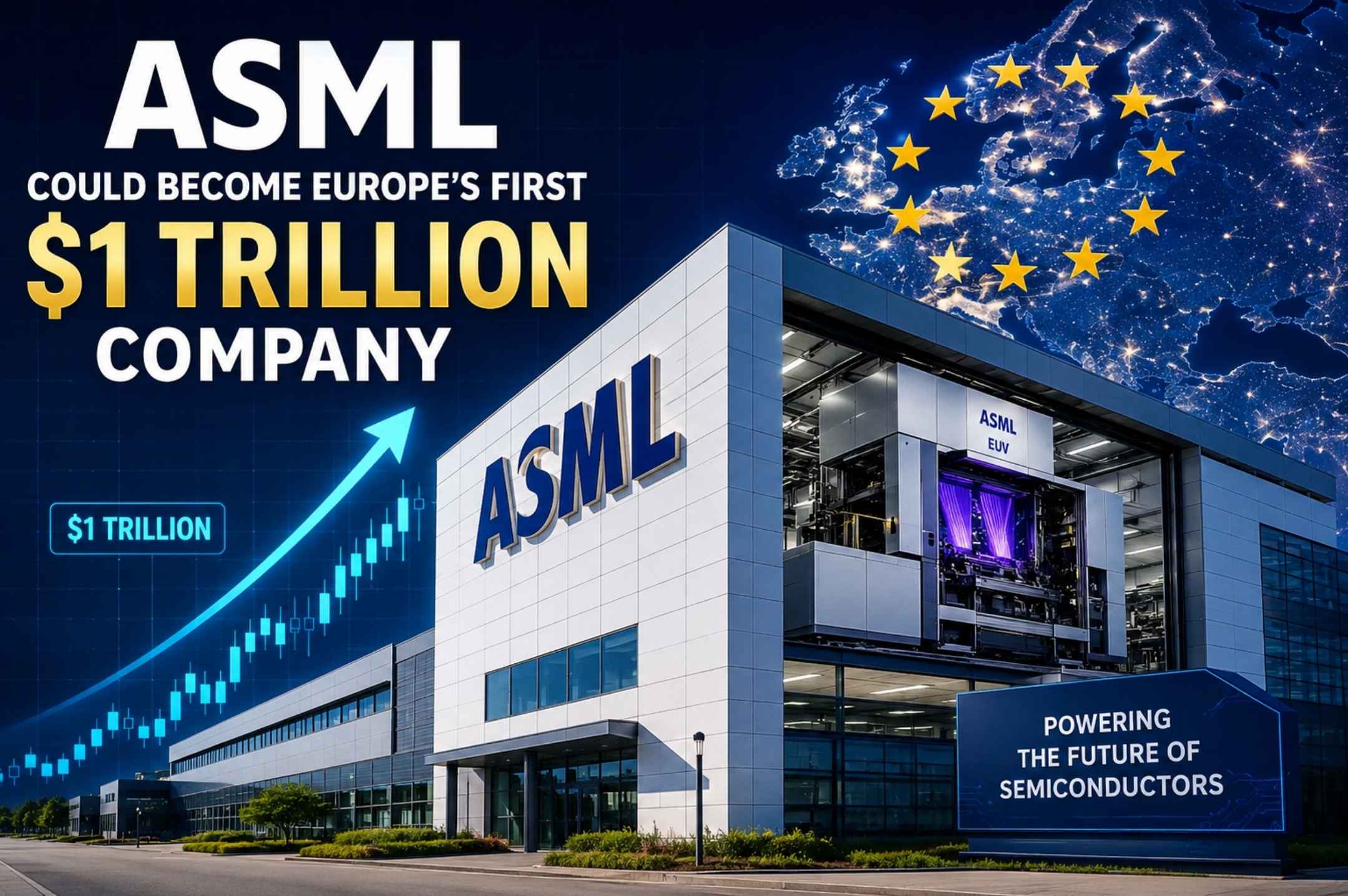
ASML Could Become Europe’s First $1 Trillion Company
ASML’s market value has climbed toward $700 billion after shares jumped roughly 60% this year. That surge is now the main focus of today’s biggest AI chip news. Could the Dutch lithography giant become Europe’s first trillion-dollar company? Following a strong second-quarter earnings report, portfolio managers and equity analysts say the milestone is now realistic.
They say it could happen within the next year or two.
This depends on AI infrastructure spending keeping its current pace.
ASML’s Stock Surge Puts a Trillion-Dollar Valuation in Sight
The scale of ASML’s rise this year stands out even against a semiconductor sector that has been on a multi-year run. A $700 billion valuation already makes ASML Europe’s most valuable company, ahead of long-time giants like LVMH. To cross $1 trillion, the stock would need to rise about 40% more.
Carolyn Bell is the lead portfolio manager at Stonehage Fleming’s Global Best Ideas fund.
She said this is a realistic target, not a stretch.
ING analyst Marc Hesselink used similarly direct language, saying ASML can reasonably reach that mark. What separates this moment from past AI-driven rallies is confirmed earnings growth. It is not backed by speculative positioning alone. This is the kind of signal that tends to hold up under institutional scrutiny.
Why ASML Sits at the Center of the AI Chip Boom
To see why people compare a Dutch machine-tool maker to the biggest tech firms, follow the money in AI chips.
ASML’s Monopoly on EUV Lithography
ASML is the only company in the world that makes extreme ultraviolet, or EUV, lithography machines.
Manufacturers need these machines to print the smallest and most advanced transistor patterns on silicon wafers. Every leading-edge processor built today, whether it powers a data center, a smartphone, or an AI training cluster, depends at some point on ASML’s tools.
That monopoly position means ASML doesn’t need to pick winners among chip designers. Whether the demand comes from an Nvidia AI chip destined for a hyperscale data center or an AMD AI chip built for a competing training platform, both ultimately rely on fabrication capacity that runs through ASML’s machines.
How Demand From TSMC and Samsung Flows Back to ASML
Taiwan Semiconductor Manufacturing Co. and Samsung are ASML’s two biggest customers. Both are racing to expand advanced-node capacity. They want to keep up with orders from chip designers.
As demand for AI accelerators pushes foundries to use more advanced process nodes, they order more EUV systems from ASML. This creates a demand chain that starts with AI software companies and ends at ASML’s factory floor in Veldhoven. This is the mechanism that turns broader AI chip news today into direct revenue for ASML, even though the company itself never designs a processor.
The Case for ASML Reaching $1 Trillion
Blowout Earnings and What They Signal
ASML’s latest quarterly results beat expectations by a wide margin. This changed how analysts model the rest of the year.
Strong booking numbers matter more to investors than one quarter’s revenue. They show how much future demand people have already locked in. That combination of near-term profitability and forward visibility is what pushed several research desks to revisit their price targets upward within days of the report.
Analyst Price Targets Pointing Toward the Milestone
Barclays, Bernstein, and Susquehanna have each raised their 12-month price targets to above $2,600 per share. That level would put ASML near a trillion-dollar market value. Antoine Hucher of Aviva Investors framed the outcome as dependent on execution. If ASML continues to deliver on its roadmap and AI-related capital spending stays elevated, the company has a credible path to becoming the first European name to reach that valuation tier.
The EUV Upgrade Cycle Among Memory Chipmakers
A less-discussed driver comes from memory manufacturers. Kinngai Chan of Summit Insights Group said AI memory makers like SK Hynix, Samsung, and Micron are changing production.
They are moving away from older deep ultraviolet, or DUV, tools.
They are shifting toward newer EUV systems with higher margins. This upgrade cycle matters because it creates a new revenue stream beyond logic chip production. It also expands ASML’s customer base beyond the few companies that dominate AI chip news today.
New Demand Sources Beyond Hyperscalers
Elon Musk’s Terafab Plant and Its Potential Impact
A newer factor in ASML’s growth story is the Terafab plant planned by Elon Musk in Texas.
It aims to supply chips for SpaceX and Tesla. If the plant moves forward as described, it would create a new source of EUV tool orders.
This demand would come from outside the usual hyperscaler and foundry customer base.
It would add another layer of demand.
ASML did not include this demand in its forecast a year ago.
The Risks That Could Slow ASML’s Climb
Uncertainty Over Hyperscaler Capital Spending
The single largest risk to the trillion-dollar scenario is how long Google, Amazon, Microsoft, and Meta continue spending at their current pace on data center buildouts. Hyperscaler capital spending has driven almost every major AI chip headline this year. If that spending slows, the impact would spread to TSMC and Samsung. It would then reach ASML’s order book.
Execution Risk Across the Supply Chain
ASML’s growth doesn’t happen in isolation. Its manufacturing capacity, suppliers’ on-time component delivery, and TSMC and Samsung expansion plans must all stay in sync. A delay at any point in that chain can push out revenue recognition even when underlying demand remains strong.
AI Stock Volatility and the Path Forward
Hucher’s caution is worth repeating: recent swings in AI-related stocks show the path to $1 trillion won’t be smooth. Sharp pullbacks tied to shifting sentiment on AI spending, regardless of ASML’s own fundamentals, remain a realistic near-term risk.
What This Means for the Broader AI Chip Market
ASML’s trajectory is a useful lens for reading the rest of the sector. NVIDIA confirmed about $1 trillion in AI chip demand through 2027 from major tech companies. Its Blackwell platform is reportedly sold out until mid-2026.
AMD has expanded its Instinct MI400 lineup.
It now includes the MI455X and MI440X accelerators.
This positions AMD as a credible second supplier for hyperscalers and AI labs. Both companies rely on the same advanced-node manufacturing capacity enabled by ASML’s EUV tools. This is why ASML’s valuation has become a barometer for AI infrastructure spending. It is not just a story about one Dutch company.
Could ASML Really Become Europe’s First Trillion-Dollar Firm?
The evidence leans toward yes, but with real conditions attached. ASML’s monopoly on EUV lithography supports the bull case from analysts at ING, Aviva Investors, and Stonehage Fleming.
Its growing customer base across logic and memory chipmakers also supports this view.
New demand sources, like the Terafab project, add more support. At the same time, the outcome still depends on factors outside ASML’s control.
Hyperscaler spending may or may not stay at its current level. TSMC and Samsung may or may not expand on schedule. AI-related market volatility must also remain contained.
What’s clear is that ASML is no longer a niche industrial name discussed only among semiconductor specialists. It has become one of the clearest ways to measure if the AI chip boom will last. The next few quarters will likely show how soon Europe gets its first trillion-dollar company.

- Tags :
- Breaking
Recent Comments
- No comments yet. Be the first!